
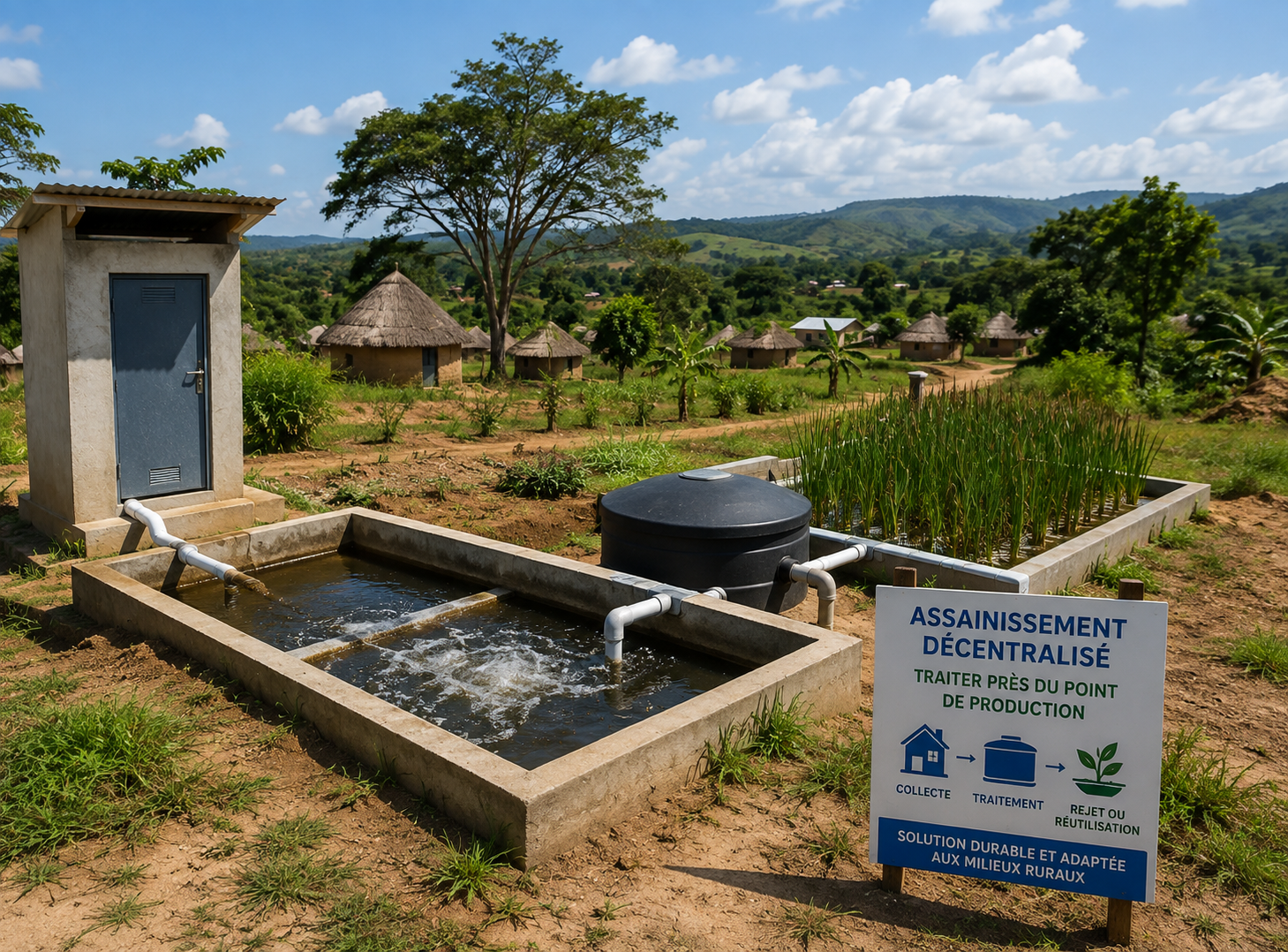
Connecting scattered housing to a centralized sewer network is expensive — the bulk of the cost lies in the piping, not the treatment plant. Below a certain population density, the logic reverses: treating water near the point of generation becomes more economical and more robust.
The Principle
Decentralized wastewater treatment involves treating wastewater at the scale of an individual home, a hamlet, or a small community, rather than transporting it to a single facility. It applies to rural areas as well as isolated sites, work camps, and infrastructure far from sewer networks.
Available Treatment Options
The choice depends on the target discharge quality, available footprint, and on-site operational skills. Extensive systems — sand filters, constructed wetlands, artificial marshes — require land area but little energy and simple maintenance. Intensive systems — compact biological reactors, membrane bioreactors — occupy little space and achieve high effluent quality, at the cost of higher energy consumption and more demanding technical oversight. Electrochemical processes represent a complementary pathway, particularly when specific contaminants must be targeted.
The Cold-Climate Constraint
In northern climates, the performance of biological processes drops with temperature: microbial activity slows down, and freezing periods require specific design considerations — burial, insulation, and buffer structures to smooth seasonal surges. This constraint is critical and must be integrated right from the design stage, rather than corrected after the fact.
Operation Remains the Weak Link
Experience shows that the primary difficulty is organizational rather than technological. A decentralized facility without a designated manager, routine monitoring, or a maintenance budget degrades quickly. Establishing the operational model — who inspects, how often, and with what funding — impacts the outcome just as much as the choice of technology.
This topic is covered in reference books co-edited by Prof. Drogui, particularly focusing on treatment in cold environments and its techno-economic aspects.