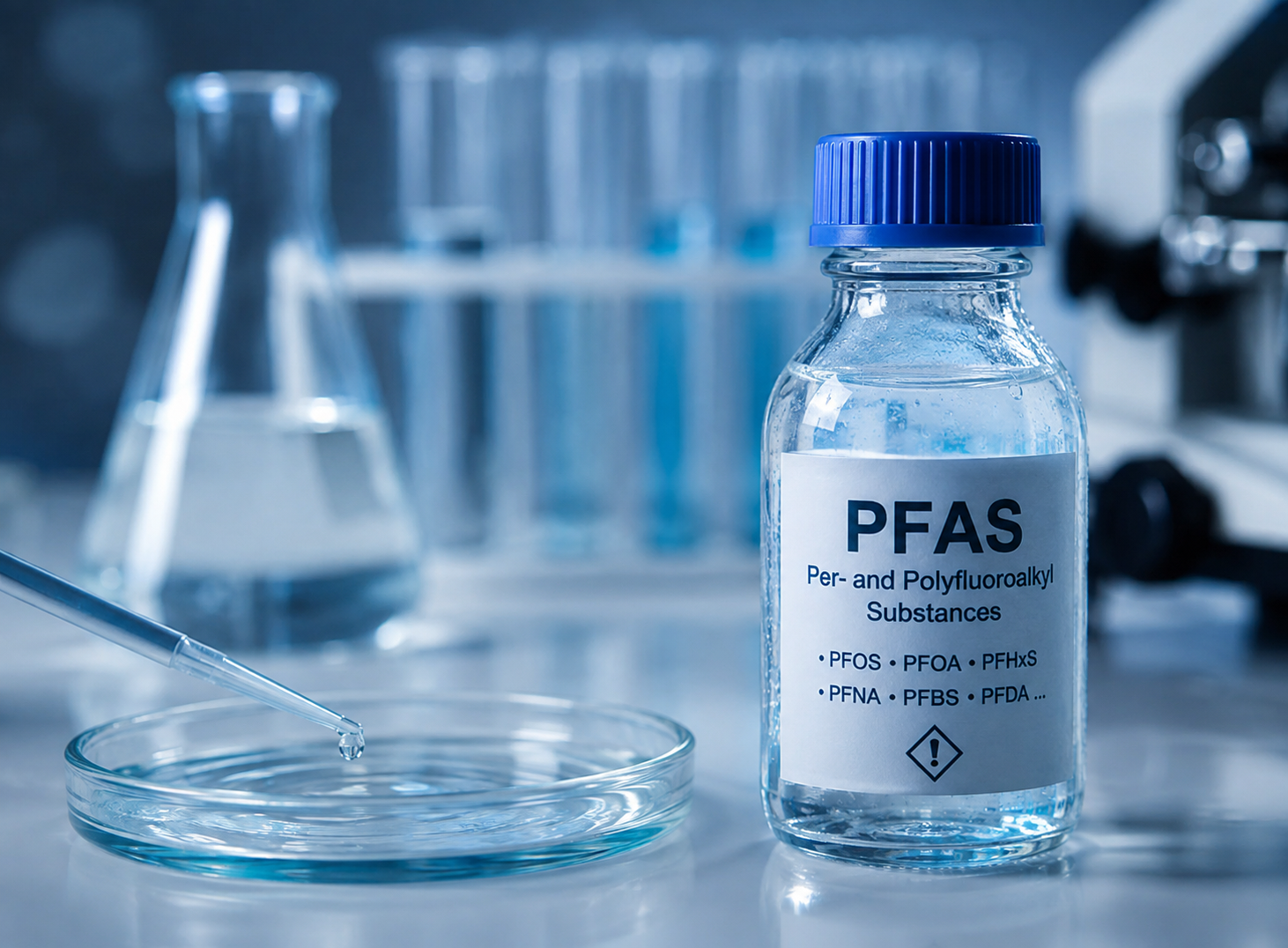
Per- and polyfluoroalkyl substances — PFAS — encompass several thousand synthetic compounds used since the 1950s for their non-stick, waterproofing, and heat-resistant properties. They are found in firefighting foams, coatings, certain textiles, and packaging.
Why are they called "forever chemicals"?
Their defining feature is the carbon-fluorine bond, one of the strongest in organic chemistry. This stability, desirable for industrial uses, turns against the environment: PFAS virtually do not degrade under natural conditions and accumulate in soil, groundwater, and living organisms.
Why conventional treatment systems fall short
Conventional wastewater treatment plants were designed to remove biodegradable organic matter and nutrients. However, PFAS resist biological treatment: they pass through activated sludge without significant transformation, partition between treated water and sludge, and end up either discharged into the receiving environment or transferred to soil during biosolids land application.
Available approaches and their common limitation
Several processes currently allow the removal of PFAS from water: activated carbon, ion-exchange resins, nanofiltration, and reverse osmosis. All share a key characteristic to keep in mind when designing a treatment train: they concentrate the pollutant rather than destroy it. The spent media or concentrate then becomes a waste stream to manage.
Destructive processes — advanced oxidation, electrochemical processes, high-temperature thermal destruction — aim to break the carbon-fluorine bond. They are currently subject to active research and initial deployments, but their efficiency and cost depend heavily on the treated matrix and the chain length of the target compounds.
An evolving regulatory framework
Regulations governing PFAS are evolving rapidly in both Canada and Europe, concerning drinking water thresholds as well as restrictions on industrial uses. Investment decisions benefit from factoring in this regulatory trajectory rather than relying solely on the rules in effect at the time of the study.
PurEau-Experts supports businesses, municipalities, and organizations in characterizing their effluents and selecting treatment systems tailored to their context.